The single most useful rule in interview dressing is this: dress one level above the company’s everyday norm.
A Wall Street analyst interview and a startup engineering interview are not the same event, and showing up in a full three-piece suit to a Series A startup can read as badly as showing up in chinos to Goldman Sachs. The goal isn’t maximum formality — it’s matching the room and then nudging slightly upward to signal you took it seriously.
This guide breaks down exactly what that means by industry and by role, with specific affordable brands and real price points. No brand is paying to be here — these are just the ones that deliver.
The Core Principle: Match the Industry, Then Go One Notch Up
Interview attire falls on a spectrum:
- Business formal — a matched suit and tie
- Business professional — a suit, often without the tie, or a blazer with dress trousers
- Business casual — dress trousers or chinos with a button-down, blazer optional, no tie
- Smart casual — elevated separates, dark jeans acceptable in some settings
Most white-collar roles — sales, marketing, engineering, operations, HR at non-senior levels — sit at business casual, and a blazer added on top handles almost any surprise. The mistake most candidates make isn’t underdressing; it’s failing to research which end of the spectrum the specific company sits on.
What to Wear by Industry

Finance, Banking, Law, and Consulting — Business Formal
This is the one category where the old rules fully apply, and if anything they’ve tightened. Return-to-office mandates from JPMorgan, Goldman Sachs, and the major banks have made finance dress codes slightly more formal than during the pandemic years.
A full matched suit, no exceptions. Navy or charcoal only — not grey, not brown. A white dress shirt is safest; light blue is acceptable. A conservative tie in solid navy, solid burgundy, or a very subtle pattern, roughly 2.75–3.25 inches wide to match your lapels — no skinny ties, no novelty patterns. Black or dark brown cap-toe oxfords, polished. No loafers — loafers are for after you get the job. Skip peak lapels and double-breasted jackets for interviews; they read as fashion-forward in a room that rewards restraint.
When unsure in finance, over-dress. Nobody has ever lost an offer for being too polished at a banking interview.
Corporate, Enterprise Tech, B2B Sales, Healthcare Admin — Business Professional to Business Casual
The broad middle of white-collar work. Enterprise software, SaaS sales, operations, government, and client-facing healthcare administration expect business professional, but modern touches read as current rather than stiff — micro-textured suit fabrics, slightly softer tie patterns.
A suit without a tie works here, or a blazer with dress trousers and a quality button-down. Navy blazer with grey trousers is one of the most reliable combinations in menswear. Leather derbies or oxfords, or clean leather loafers, all work.
Startups, Software Engineering, R&D — Smart Casual
Tech and startup interviews usually reward smart casual over a full suit. Showing up in a three-piece can signal you misread the culture — but “casual” still means elevated, not sloppy.
A blazer or fine-gauge sweater over a quality dress shirt (no tie), with chinos or dark trousers. A fine-gauge merino V-neck in charcoal or navy adds polish in colder months without bulk. Clean leather shoes, or minimal high-quality sneakers in the most casual environments. A blazer over a plain tee works where the culture is genuinely relaxed — but the blazer stays.
The video-interview upgrade: even when the role is casual, wearing a blazer or sport coat on camera immediately elevates you above every candidate who showed up in just a shirt. It costs nothing and the subconscious signal is real.
Creative, Marketing, Design, Media — Polished Casual
The one category where personality is an asset. A statement piece over clean basics shows you understand the field. Elevated tailoring still beats casual separates — a well-fitted blazer, an interesting but not loud shirt, quality trousers. You have room for texture and subtle color that finance would reject outright.
Retail and Hospitality — Match the Brand
Uniquely, these interviews reward researching the specific brand’s aesthetic and reflecting it. Interviewing at a minimalist brand? Dress minimalist. A rugged, casual brand? Adjust accordingly. Business casual is the safe floor, but brand alignment is the real differentiator.
Quick Reference: Dress Code by Industry
| Industry | Expected Level | Safe Outfit | Colors |
|---|---|---|---|
| Finance / Law / Consulting | Business formal | Navy/charcoal suit + tie + oxfords | Navy, charcoal, white |
| Corporate / Enterprise tech | Business professional | Suit (no tie) or blazer + trousers | Navy, grey, soft blue |
| Healthcare admin / Government | Business casual+ | Blazer + button-down + trousers | Navy, white, soft blue |
| Startups / Engineering | Smart casual | Blazer + shirt (no tie) + chinos | Any neutral + one accent |
| Creative / Marketing | Polished casual | Blazer + textured shirt + trousers | Bolder allowed |
| Retail / Hospitality | Reflects the brand | Research the brand’s aesthetic | Match brand vibe |
Colors That Work (and the Ones to Avoid)
The neutral core works in every industry: navy, charcoal, grey, black, white, and beige.
- Navy is the single most useful color in professional dress — authoritative without being severe, and it flatters nearly everyone. If you buy one suit or blazer, make it navy.
- Charcoal and grey are the reliable alternatives, slightly softer than black.
- White shirts project formality and are safest for conservative fields. Light blue adds approachability and works everywhere.
- Darker, solid neutrals project authority and minimize distraction — exactly what you want when you need the interviewer focused on your answers, not your outfit.
Avoid: bright reds, neons, heavy patterns, and busy prints. On video specifically, tight patterns, stripes, and checks can shimmer and create a distracting moiré effect on camera — even on an expensive shirt. Solids photograph cleaner.
Affordable Brands That Actually Deliver
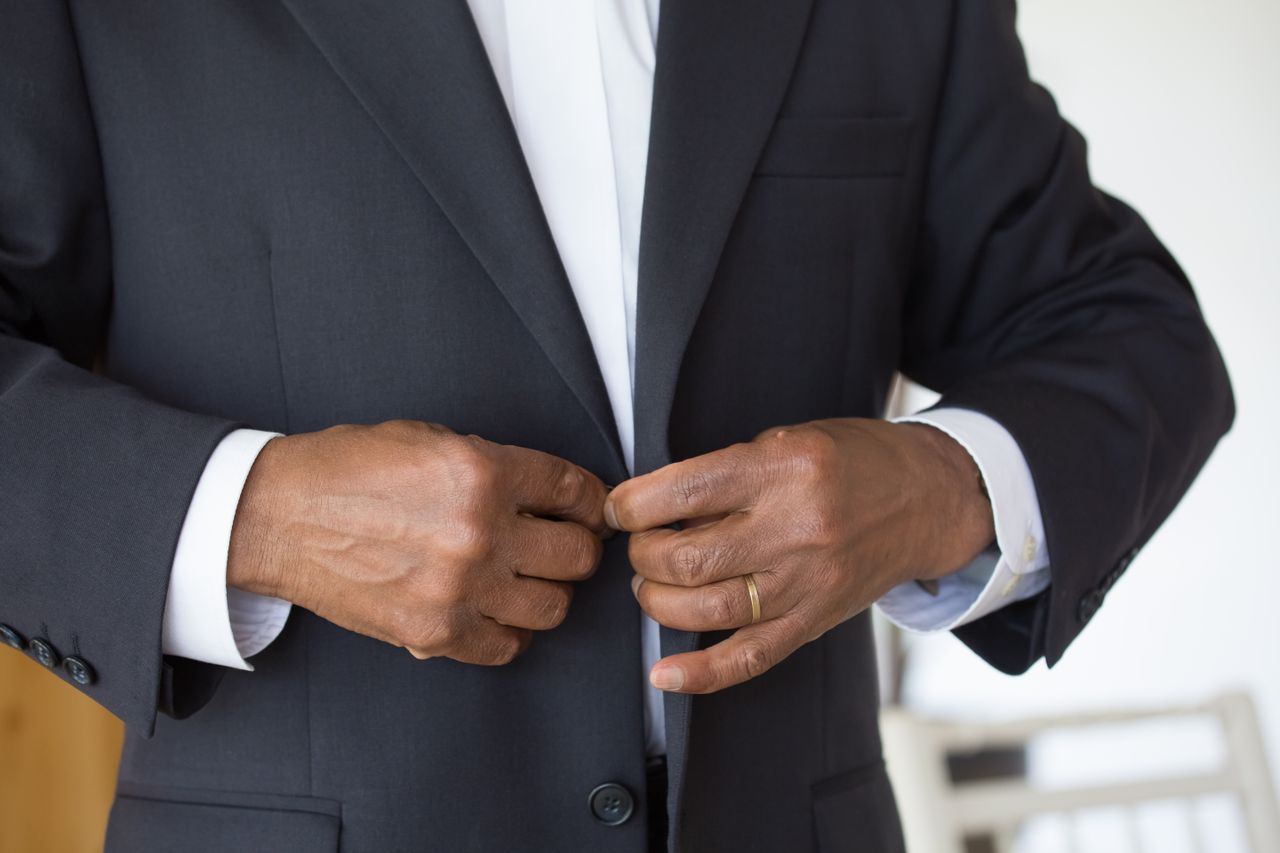
You do not need an expensive suit. The single biggest lever in how a suit looks is fit, not price — a well-fitted $200 suit beats a poorly fitted $600 suit every time. Here’s where to actually shop, by budget.
Under $300 — The Value Sweet Spot
- SuitShop — suits start around $200, genuinely sharp, one of the best budget options for a first interview suit
- J.Crew (Ludlow, Crosby lines) — frequently on sale into this range with stackable promo codes around holidays; stretch wool and wool blends
- Uniqlo — excellent for dress shirts, blazers, and smart-casual separates at low prices; a reliable stop for the tech/startup look
- Amazon Essentials — reliable basics with easy returns; fine for shirts and separates
- Charles Tyrwhitt — wool-rich blends, classic styling, and near-constant sales that push shirts and even suits into value territory
Key insight: the $150–$300 window is where smart shoppers find real value — decent fabric, structured shoulders, and a silhouette that doesn’t read as clearance rack. Below $150 usually means compromises in lining and construction.
$300–$700 — The Long-Term Investment
- Suitsupply — the benchmark for value tailoring; half-canvas construction and European wools that punch well above price. Core suits run roughly $499–$699. Worth it if you’ll wear a suit regularly. Fits like Napoli and Lazio cover slim to classic builds.
- Spier & Mackay — higher wool counts and refined patterns; competes hard on quality per dollar
- Bonobos — strong for fit across body types, good separates
- Brooks Brothers — American classic, reliable navy and charcoal
The universal money-saver: buy the jacket and trousers as separates where possible, and budget $30–$60 for a local tailor to take in the fit. Fit can be affordable — an off-the-rack suit with $50 of alterations looks better than most things twice its price. Get the shoulders right in the store, since that’s the hardest thing to alter; a tailor can handle nearly everything else.
Fit, Grooming, and the Details Interviewers Actually Notice
Fit beats everything. A suit that sits clean through the shoulders — no bunching at the back, no swallowing your frame — always reads better than a pricier suit that doesn’t fit.
Iron or steam everything. A wrinkled shirt undoes a good outfit instantly.
Shoes get noticed. Interviewers do look at feet. Polished leather signals attention to detail; scuffed leather signals the opposite.
Grooming: clean, styled hair; neat, trimmed facial hair; fresh, minimal fragrance, or none — some interviewers have sensitivities; tidy nails. For conservative fields, cover visible tattoos if you’re unsure.
On video: a structured collar is the single most impactful detail, because your face and collar are most of what the interviewer sees. A limp collar looks sloppy; a structured spread collar frames your face. Wear a jacket, and if your background is light, a darker jacket creates flattering contrast.
Common Mistakes
- Underdressing because “the office is casual.” The daily dress code and the interview dress code are different things. Dress one level up regardless.
- A suit that doesn’t fit. More common and more damaging than a cheap suit. Fit is free to prioritize and cheap to fix.
- Loud patterns or colors that pull attention away from your answers.
- New shoes you haven’t broken in — blisters are a genuine distraction mid-interview.
- Over-accessorizing. One good watch, a simple belt that matches your shoes. That’s plenty.
- Ignoring the video-specific rules when the interview is remote — collar structure and a jacket matter more on camera than in person.
The Bottom Line
Research the company first — its industry, its actual daily dress code, its culture — then dress one clear level above that. Finance and law want a full suit in navy or charcoal. Most corporate, sales, marketing, and engineering roles want business casual with a blazer. Startups want smart casual, elevated. Creative fields give you room for personality.
Buy for fit, not for a label. A $200 suit that fits you properly, in navy, pressed and paired with polished shoes, will out-perform almost anything more expensive that doesn’t — in any interview, in any industry.
Once you’ve got the outfit sorted, the rest of your preparation matters just as much. Our guides on what to bring to an interview and 50 unique interview questions to ask an employer cover what happens after you walk in the door — and before you accept any offer, research the company at WiseWorq to know what you’re actually walking into.
Related WiseWorq Guides
- What to Bring to an Interview — everything else to have ready before you walk in
- 50 Unique Interview Questions to Ask an Employer — what to ask once you’re in the room
- 40 Best Questions to Ask at the End of an Interview — closing strong
- Phone Interview Questions — nailing the screening call that comes first
- How Long After an Interview Should You Follow Up? — the next step after the interview