
Short answer: yes, HR is a good career for the right person — strong pay ceiling, genuine six-figure path to the C-suite, and broad specialization options. But it also carries one of the highest burnout and turnover rates of any corporate function, and the day-to-day reality varies enormously depending on which corner of HR you actually work in. This guide breaks down real pay by specialty, what practitioners say on Reddit and Glassdoor, and who this career genuinely fits.
HR Isn’t One Job — It’s at Least Six
The biggest mistake people make researching this career is treating “HR” as a single role. It isn’t. Someone processing payroll for a warehouse and someone negotiating executive compensation at a tech company are both “in HR,” and their jobs have almost nothing in common. Here’s the real breakdown, with current US pay data.
| HR Specialty | What It Actually Involves | Typical Salary (2026) |
|---|---|---|
| HR Generalist | The all-rounder role — onboarding, employee relations, policy, compliance, some recruiting | $67,917 average, climbing to $125K+ senior; $83,000 US median per Coursera’s Glassdoor-sourced data |
| Corporate Recruiter (in-house) | Sourcing and screening candidates for your own company | Base pay plus bonus; frequently described as less competitive than market by recruiters themselves, per Payscale-collected reviews |
| Headhunter / Executive Search | Third-party, often commission-heavy, filling specialized or senior roles for client companies | Commission-driven; agency headhunters can earn $50,000+ per successful executive placement, but income is inconsistent and candidate-side sentiment toward agency recruiters is notably harsh (more below) |
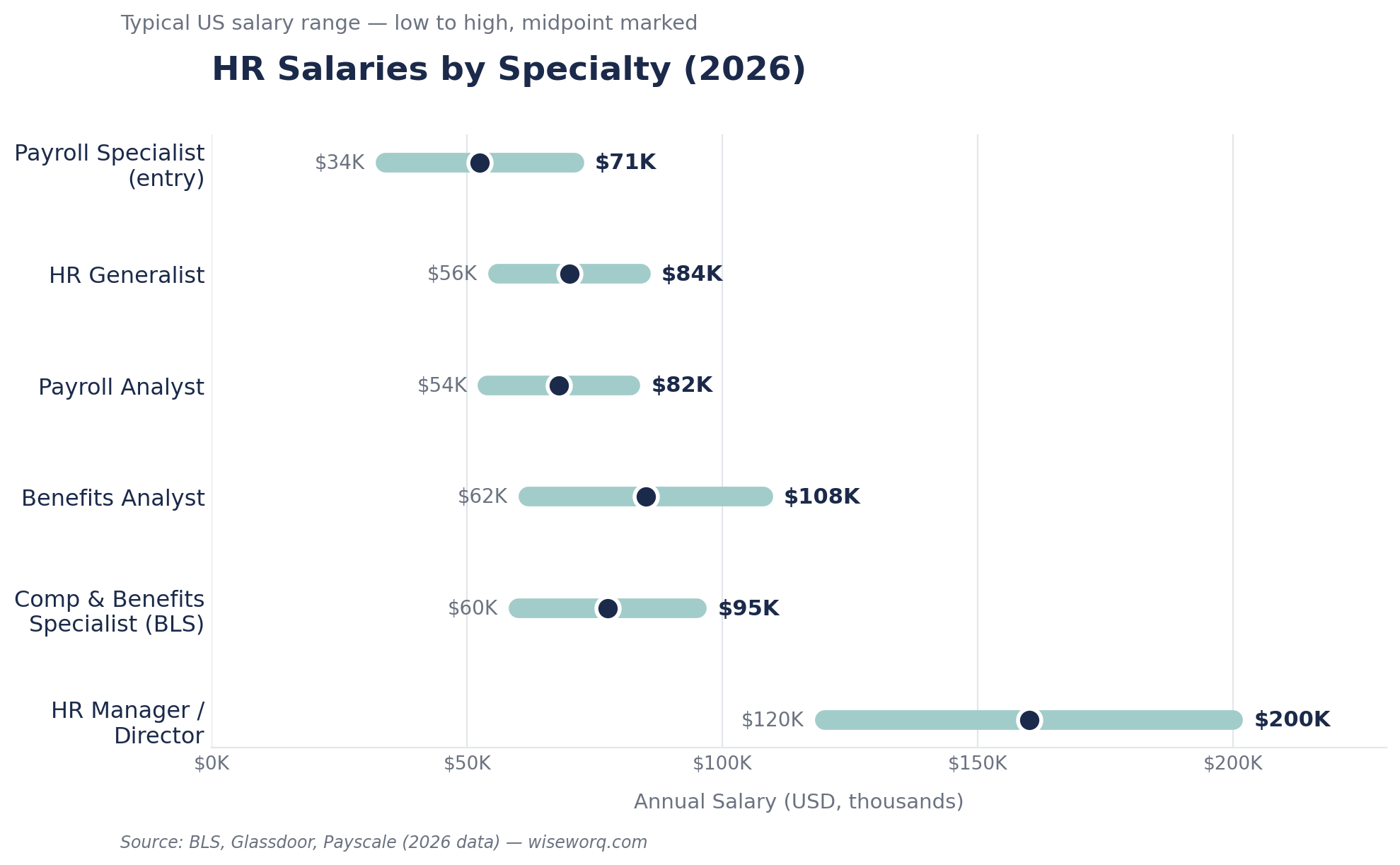
| Payroll Specialist / Analyst | Processing pay, tax withholding, compliance, timekeeping accuracy | $33,955–$71,089 depending on seniority; $70,063 average per Payscale; highest-paying industries are legal ($76,829) and aerospace/defense |
| Compensation & Benefits Analyst | Salary benchmarking, bonus structure design, administering benefits and flexible/cafeteria-style plans | $78,210 median per the Bureau of Labor Statistics; $87,109 average for Benefits Analyst specifically |
| HR Manager / Director | Leading the function, managing generalists and specialists, sitting closer to executive decision-making | $161,000 US median per Coursera’s data |
One detail worth flagging on bonus calculations specifically: comp & benefits professionals are the ones who actually design how bonus pools, commission structures, and merit increases get calculated across a company — it’s a genuinely technical, analytical corner of HR, closer to finance than to “people skills,” and it pays accordingly.
Blue-Collar HR vs. White-Collar HR: A Different Job Entirely
This distinction matters more than most career guides admit, and it’s a real fork in the road if you’re choosing where to specialize.
White-collar HR — the corporate office environment most people picture — deals with salaried employee relations, performance management, remote/hybrid policy, and standard benefits administration.
Blue-collar HR operates in a genuinely different world. As one industry breakdown puts it, blue-collar employers navigate OSHA standards, industry-specific safety regulations like DOT for transportation and MSHA for mining, workers’ compensation requirements that vary by state, and often collective bargaining agreements — “compliance capacity is part of the cost of doing business in these sectors, and it affects workforce management in ways that don’t show up in white-collar HR.”
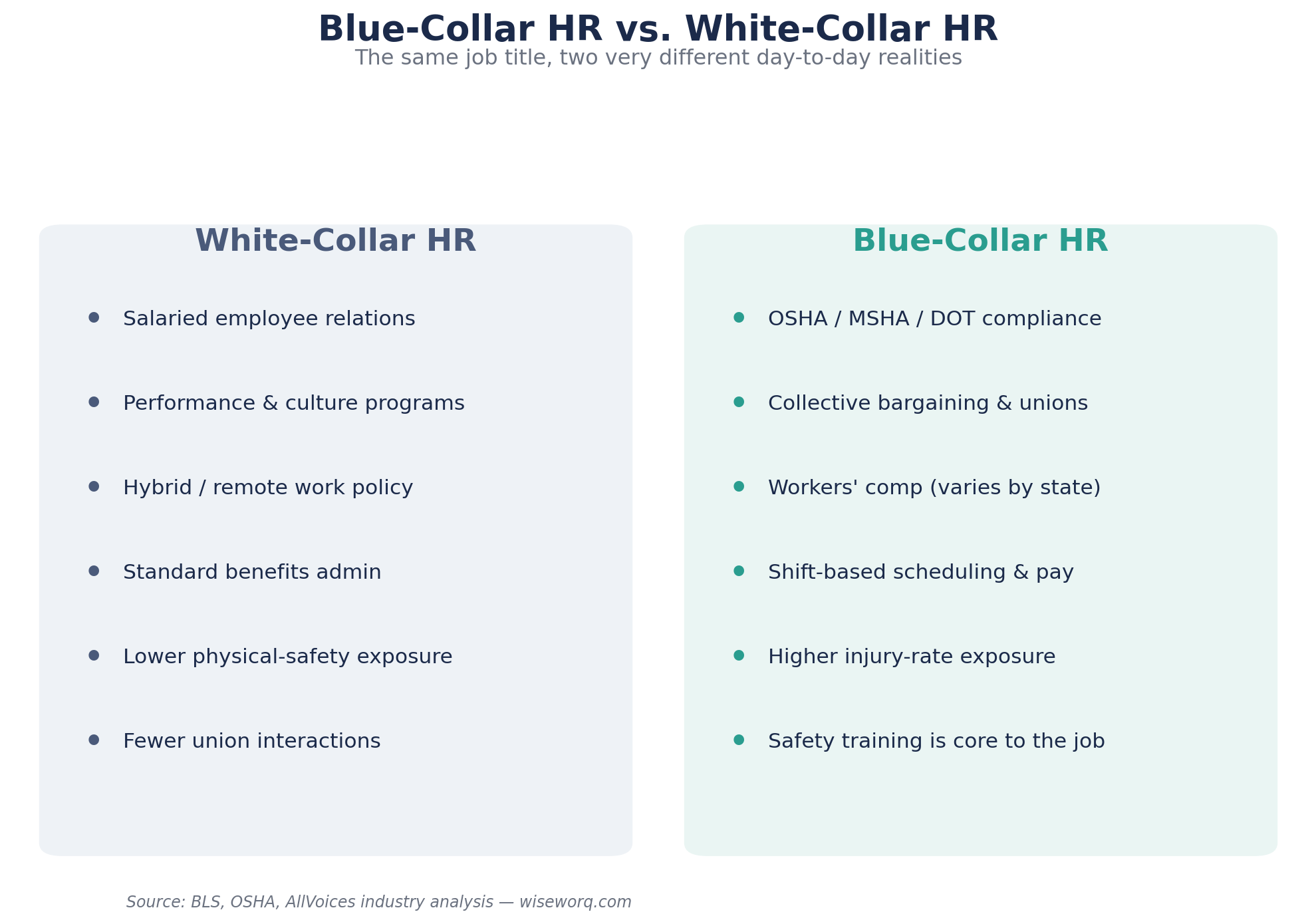
Fatal injury rates in these industries run several times higher than white-collar settings, which changes what HR’s actual job is day to day — safety compliance and union relations become as central as recruiting and benefits.
Practical takeaway: if you’re choosing a specialization, HR inside manufacturing, logistics, construction, or utilities is a meaningfully different career from HR at a software company — more regulatory, more union-facing, often more procedural. Neither is “easier,” but they reward different strengths.
What Real HR Professionals Actually Say
This is where the honest picture comes together — and it’s more mixed than most “is HR a good career” articles admit.
Burnout is not a fringe complaint — it’s the headline statistic. SHRM found that 83% of HR professionals experience some form of anger, dissatisfaction, or burnout during a typical workday, and a Gallup survey separately concluded HR professionals are among the most stressed-out professionals in the world.
It gets worse: HR had the highest turnover rate of any position tracked on LinkedIn in 2022. A Lattice survey found 41% of HR professionals report their department is understaffed, which means the people managing everyone else’s workload complaints are frequently drowning in their own.
A real account posted on the professional forum Blind captures this precisely: “Currently working in HR/People space for the past almost 4 years… I left the job I was at for 3 years cuz I was so burnt out… still feel burnt out, stressed and overwhelmed.” The response she got was blunt: “If you find the role of HR stressful — you are likely not cut out for corporate life.” That exchange alone tells you a lot about how normalized burnout has become in the field.
On the recruiting side, the reviews split sharply by which side of the desk you’re on. A corporate (in-house) recruiter reviewing their own job on Payscale offered a fair, mixed take: “I don’t like when I feel like a salesperson. I try to avoid selling opportunities to people and sometimes as a recruiter you can be forced to push people into positions that aren’t always a good fit.” Another cited pay that “is not competitive with market” despite genuinely liking the team culture.
Agency headhunting gets a rougher review from the people on the receiving end. Candidate sentiment toward third-party headhunters on Blind is often scathing: “I’ve spoken to more than 20 throughout my career and not a single one of them has managed to secure an interview for me.” Another: “The independent recruiters didn’t offer anything more than lies, intense pressure and bitterness over any success I got in the job market without their ‘aid.'” One Blind commenter summed up the structural issue plainly: “Their objective is not fully aligned with yours” — a headhunter is paid by and works for the hiring company, not the candidate, however friendly the relationship feels. If you’re considering agency recruiting as a career, know that this skepticism is exactly what you’ll be up against daily.
Ghosting culture is a recurring complaint from the recruiter’s side too. One recruiting professional admitted candidly on Blind: “Recruiters have a ghosting quota that needs to be met” — a startling but honest window into how volume-driven and impersonal high-throughput recruiting can become.
What are the Benefits of Starting a Career in HR?
None of the above means HR is a bad career — it means it’s an intense one with real trade-offs, and the upside is equally real.
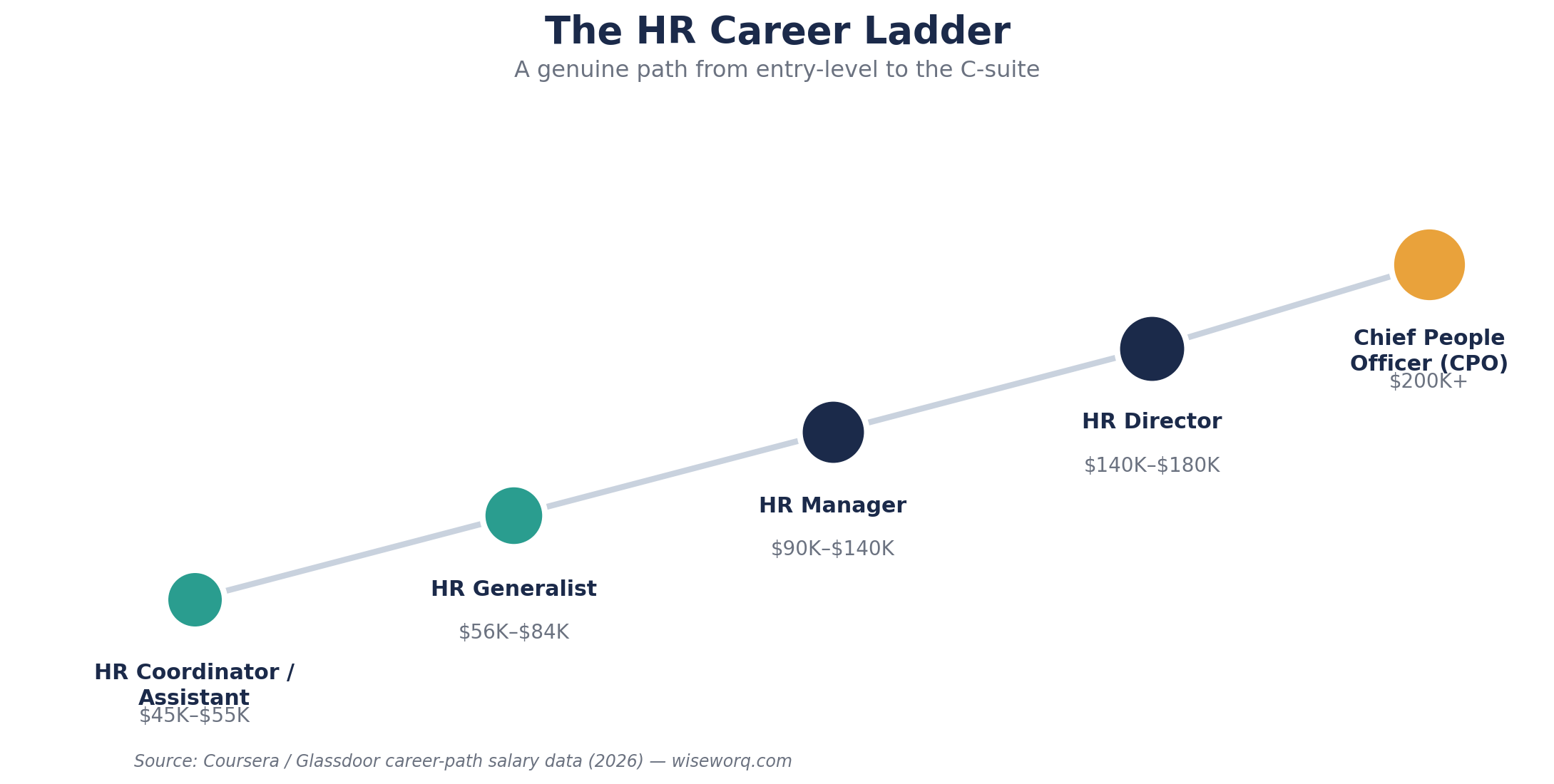
The six-figure path is genuine, not aspirational marketing. HR management salaries reach $161,000 at the median, and specialist tracks like compensation and benefits regularly clear $85,000–$100,000+ without requiring an MBA. 73% of HR generalists report being satisfied with their salary specifically, a genuinely high figure for a corporate function.
The variety is real, and it’s one of the field’s strongest selling points. Unlike careers with an early ceiling, HR spans generalist work, deep specialization (comp & benefits, L&D, HRIS/people analytics), recruiting, and a legitimate path to Chief People Officer — a seat that increasingly sits in the C-suite and boardroom, not the back office.
Certifications provide a measurable pay lever. Credentialed HR professionals — SHRM-CP, PHR, and similar — consistently earn more than non-certified peers and gain real leverage in salary negotiations, which is a more direct return-on-credential than many corporate fields offer.
It’s comparatively insulated from AI displacement — for now. The relationship-heavy, judgment-dependent, legally sensitive parts of HR (employee relations, investigations, culture, negotiation) are difficult to automate. The transactional parts — payroll processing, basic benefits administration, resume screening — are the ones already being reshaped by HR software and AI tools, which is worth factoring into which specialty you choose.
Who Should Actually Go Into HR?
A strong fit if you: genuinely enjoy problem-solving around people and process, can hold boundaries without absorbing everyone else’s stress, want measurable career progression with real specialization options, and are drawn to the analytical corners of the field (compensation design, people analytics, benefits) as much as the interpersonal ones.
Think harder if you: need a low-stress, predictable role — the SHRM and Lattice data above make clear this isn’t reliably that. You’re specifically drawn to agency recruiting for the commission upside without accounting for the inconsistency and the candidate-side hostility you’ll regularly face. Or you’re expecting HR to be primarily about “helping people” without the compliance, conflict, and paperwork load that actually fills most HR calendars.
Frequently Asked Questions
Is HR a stressful job? Yes, more than most corporate functions. SHRM data puts burnout-related dissatisfaction at 83% of HR professionals, and HR posted the highest turnover rate of any tracked position on LinkedIn in 2022 — largely driven by understaffing and workload rather than the work itself being undesirable.
What is the highest-paying HR job? HR Director and Chief People Officer roles top the field, with HR management salaries reaching a $161,000 median. Specialized compensation and benefits roles also pay well without requiring executive tenure.
Do you need a degree to work in HR? Entry-level generalist and coordinator roles often accept a bachelor’s degree in any field plus relevant experience. Specialized tracks like compensation & benefits or HRIS analytics increasingly reward quantitative skills and certifications (SHRM-CP, PHR) as much as the degree itself.
Is recruiting the same as HR? Recruiting is one function inside HR, not the whole field. In-house corporate recruiters are HR employees; headhunters at agencies are a distinct, often commission-based career that sits adjacent to HR rather than inside a single company’s HR department.
Is HR a good career for someone who wants work-life balance? It depends heavily on the specialty and company. Payroll, compliance, and comp & benefits roles tend to be more predictable than generalist or recruiting roles, which absorb the bulk of employee-relations firefighting and hiring-volume pressure.
The Bottom Line
HR rewards people who can specialize into the parts of the field that fit their actual strengths — analytical types thrive in compensation and payroll; people-first, resilient types can build a genuine career in generalist and employee-relations work; and the ones who make it to HR leadership do so with real, six-figure compensation to show for it. What it doesn’t reward is going in expecting a low-stress “people person” job — the data on burnout and turnover is too consistent to wave away.
If you’re weighing HR against other paths, research real employers and team-level reviews at WiseWorq before you commit — because as this guide shows, the HR department at one company can be an entirely different job from the HR department at another.
Related WiseWorq Guides
- How Many Jobs Are Available in Major Banks? — HR and recruiting roles inside large financial institutions
- Signs of a Toxic Workplace — recognizing the dysfunction HR is often asked to manage, or fails to
- How to Overcome Career Challenges — practical tactics for the burnout and workload issues covered here
- Career Change at 40 — HR is a common mid-career pivot; here’s how to plan one properly
- How to Use Job Search Engines Effectively — including how ATS and recruiter matching actually work, from the other side of the desk