
If you’re asking “what jobs do I qualify for with my ASVAB score,” you’re actually asking two separate questions — and most people don’t realize that until after they’ve already tested. Your ASVAB score does two distinct things: first, it determines whether you can enlist at all, and second, it determines which specific jobs you’re eligible for once you’re in. Those are controlled by two completely different numbers from the same test, and understanding both is the difference between walking into a recruiter’s office with leverage and walking in with none.
This guide covers what the ASVAB actually is, how it’s scored, what each score range unlocks across all six military branches, what jobs pay at various levels, the perks and bonuses tied to your score, and what to do if your current score isn’t opening the doors you want.
What Is the ASVAB?
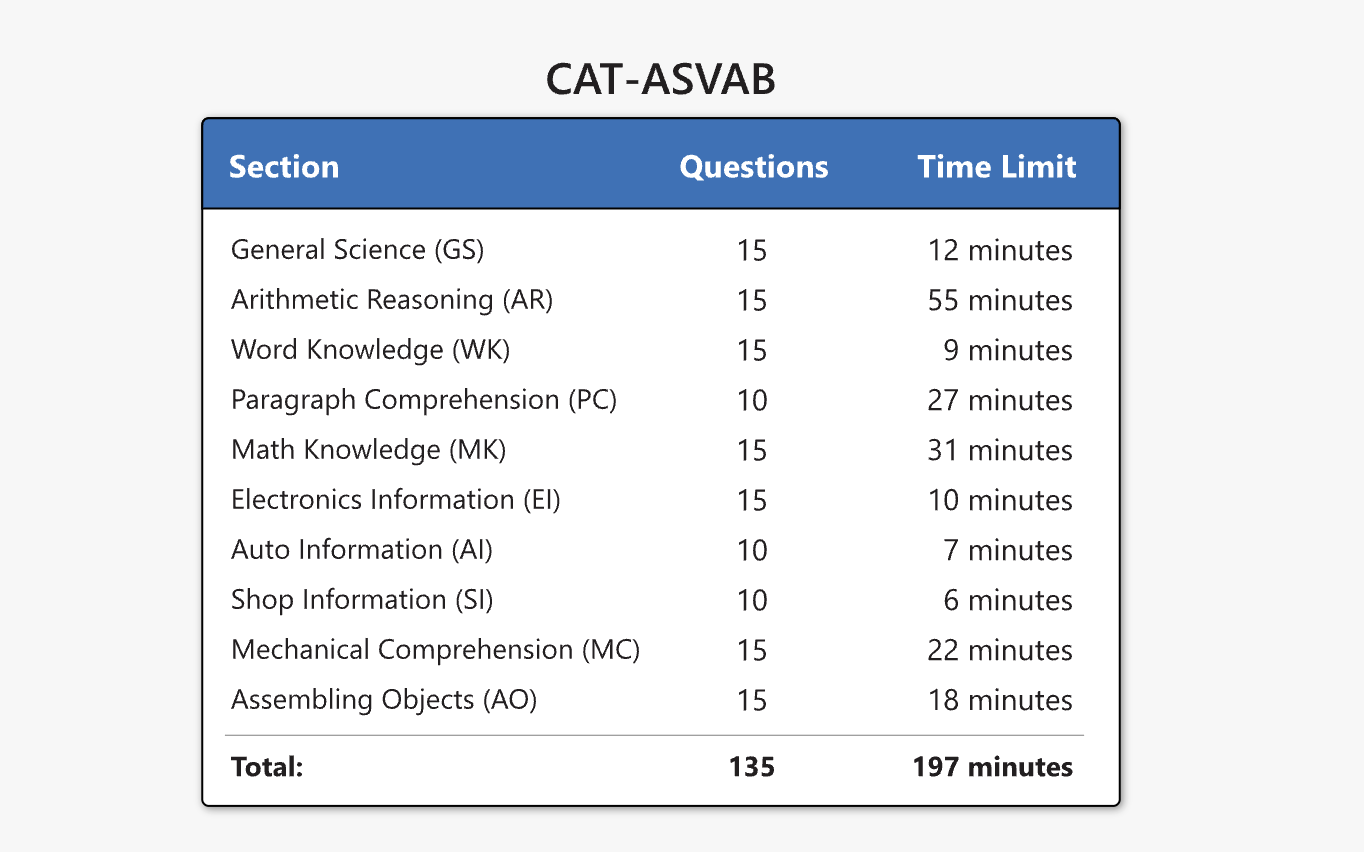
The Armed Services Vocational Aptitude Battery — ASVAB — is a standardized test taken by over 1.2 million Americans every year, both for military enlistment and as a career exploration tool for high school students. It consists of ten subtests covering:
- Word Knowledge (WK) — vocabulary and word meaning
- Paragraph Comprehension (PC) — reading comprehension
- Arithmetic Reasoning (AR) — word problems using basic math
- Mathematics Knowledge (MK) — algebra, geometry, and math concepts
- General Science (GS) — biology, chemistry, physics, earth science
- Electronics Information (EI) — circuits, electrical systems, electronics
- Auto & Shop Information (AS/AI+SI) — vehicle systems, tools, woodworking
- Mechanical Comprehension (MC) — how machines and physical principles work
- Assembling Objects (AO) — spatial reasoning and how parts fit together
- Coding Speed (CS) — speed and accuracy on a simple coding task (paper ASVAB only)
The computerized CAT-ASVAB has 10 separate subtests and takes roughly 154 minutes. The paper version combines some subtests and takes about 149 minutes. Your raw scores on each subtest are used to calculate two different types of scores that control your military future in different ways.
The Two Scores That Actually Matter
1. Your AFQT Score — The Enlistment Gate
Your AFQT (Armed Forces Qualification Test) score is a percentile from 1–99, calculated from just four of the ten subtests: Arithmetic Reasoning (AR), Mathematics Knowledge (MK), Word Knowledge (WK), and Paragraph Comprehension (PC). According to OpenExamPrep’s 2026 ASVAB guide, the formula is:
AFQT = 2VE + AR + MK (where VE = WK + PC)
A score of 50 means you scored as well as or better than 50% of test takers. It’s a percentile — not a percentage of questions answered correctly. The reference group is a nationally representative sample from 1997, which means the percentile comparison is consistent across all test dates.
2. Your Line Scores (Composite Scores) — The Job Key
While your AFQT gets you through the door, your line scores determine which specific jobs you can actually do. Each branch takes different combinations of your ten subtest scores and calculates its own composite scores — and each composite maps to a family of jobs.
For example, the Army uses 10 different line scores: GT (General Technical), CL (Clerical), CO (Combat), EL (Electronics), FA (Field Artillery), GM (General Maintenance), MM (Mechanical Maintenance), OF (Operators and Food), SC (Surveillance and Communications), and ST (Skilled Technical). Your GT score — calculated as VE + AR — is the most referenced across the Army because it gates technical, intelligence, and leadership roles. A GT of 110 or higher is considered competitive for the most desirable positions.
The key insight from ASVAB Hero’s 2026 breakdown: the minimum AFQT to enlist is just the first gate. Your composite scores are the second gate — and that’s where most people’s job options actually get determined.
Branch Minimums: What Score Do You Need to Enlist?
The following are minimum AFQT scores for high school diploma holders as of June 2026, per USMilitary.com’s verified 2026 data:
| Branch | Minimum AFQT (HS Diploma) | Minimum AFQT (GED) |
|---|---|---|
| Army | 31 | 50 |
| Navy | 35 | 50 |
| Marine Corps | 32 | 50 |
| Air Force | 36 | 65 |
| Space Force | 36 | 65 |
| Coast Guard | 40 | 50 |
Important notes:
- GED holders generally need a score of at least 50 across most branches
- The Air Force and Space Force are the most selective — a 36 minimum means you’re already in the top half of some cohorts
- The Coast Guard historically holds the highest standard but can issue waivers for recruits qualifying for high-demand jobs
- Requirements shift based on recruiting needs — always verify with a recruiter before assuming these numbers are fixed
If you have a GED but have completed 15 or more college credits, most branches will treat you as a Tier 1 applicant, meaning the lower diploma-holder thresholds apply to you rather than the higher GED requirements.
AFQT Score Categories: What Each Range Actually Means for Your Career
This is the part most websites list without explaining what it actually changes. Per ASVAB Hero’s category breakdown:
Category I (93–99): Top 8% of test takers. Qualifies for every branch and virtually every enlisted job available. Maximum recruiter priority and bonus eligibility.
Category II (65–92): Well above average. Excellent access to technical roles, signing bonuses up to $50,000 in high-demand fields, and essentially every MOS across all branches. This is where real leverage lives — recruiters actively compete for Category II candidates.
Category IIIA (50–64): Average to above average. Fully eligible for all branches. Qualifies for bonuses and the majority of available jobs. According to ASVAB Hero, crossing the 50-point threshold is “the single most impactful threshold in the enlistment process” — it separates bonus-eligible from non-bonus and opens up the majority of MOS options.
Category IIIB (31–49): Meets the minimum for most branches with a diploma. Enlistment bonus eligibility narrows significantly, and the available MOS pool shrinks. Recruiters have less incentive to negotiate on job selection at this tier.
Category IV (10–30): Federal law (10 U.S.C. 520) limits this category to no more than 4% of annual Army accessions. Options are very limited across all branches. The Army offers a Future Soldier Preparatory Course for scores as low as 21 to help recruits retest.
Category V (1–9): Disqualifies from enlistment in all branches. No exceptions.
What Jobs Do Different Score Ranges Unlock?

Scores 31–49 (Category IIIB)
At this range you can enlist in most branches with a diploma, but your job options are meaningfully limited. Available roles tend to be in combat infantry, basic support, food service, and manual labor categories. Enlistment bonuses are generally not available. If you’re in this range and want better options, it’s worth taking the time to prepare and retest — the jump from a 45 to a 55 changes your military career more than almost any other single factor.
Example accessible roles at this range: Infantry (Army MOS 11B, GT requirement around 87), Watercraft Engineer, Motor Transport Operator, Food Service.
Scores 50–64 (Category IIIA)
This is the tier where the job market opens up meaningfully. According to Peterson’s ASVAB guide, scores in this range unlock technical roles across multiple branches and make you eligible for enlistment bonuses. The range of available jobs expands significantly, particularly in healthcare, technical support, and administrative fields.
Example roles at this range: Combat Medic (Army 68W — requires ST 101 and GT 107), Information Technology Specialist, Military Police, Intelligence Analyst entry-level, Medical Technician.
Scores 65–92 (Category II)
The broadest access tier for enlisted personnel. At 65+, you qualify for virtually every enlisted position across all branches, including highly technical and specialized roles. Signing bonuses for critical MOSs are most accessible here, with some reaching $50,000 for high-demand technical and cyber fields.
Example roles at this range: Cyber Operations Specialist, Cryptologic Linguist (also requires DLAB score), Nuclear Power Program (Navy — requires specific composite scores), Special Forces Assessment (also requires physical qualifications), Intelligence roles, Aviation maintenance.
Scores 93–99 (Category I)
Everything is available. The most competitive and highest-compensated roles — Special Operations, Intelligence Community billets, nuclear programs, and cyber warfare — require not just a high AFQT but also strong line scores in specific composites. Recruiters actively recruit Category I candidates and typically offer first selection of available MOS and maximum bonus packages.
Specific Jobs by Branch: What Line Scores Unlock

Rather than an exhaustive table of every MOS (there are 140+ in the Army alone), here are examples of well-known roles and what they actually require, based on Operation Military Kids’ verified 2026 score data:
Army (MOS examples):
- 11B Infantryman: CO 87
- 25U Signal Support Systems Specialist: SC 102
- 35L Counterintelligence Agent: GT 107, ST 113
- 68W Combat Medic: ST 101, GT 107
- 89D Explosive Ordnance Disposal: ST 107
Navy (Rating examples):
- IT Information Systems Technician: AR 52 (minimum composite 171)
- CT Cryptologic Technician: Multiple composite requirements depending on specialty
- Navy SEAL: VE + MK + MC + CS = 220 minimum, or VE + AR = 110 minimum
Air Force (AFSC examples):
- Cyber Systems Operations: Strong Electronics and Math composites
- Linguist/Intelligence: High verbal composites plus DLAB test
- Pararescue (PJ): High GT plus physical qualification
Marine Corps (examples):
- 0311 Rifleman: GT 80
- 0621 Field Radio Operator: EL 95
- 2651 Signals Intelligence: GT 100, EL 95
Line score requirements are set by each branch independently and change based on recruiting needs. The specific numbers above represent commonly published 2026 thresholds — always confirm with a recruiter before banking on any specific number for a job you want.
Bonuses, Pay, and Perks Tied to Your Score
Enlistment bonuses: Up to $50,000 for high-demand technical MOSs, generally available to Category II and above. Bonuses are not available to Category IIIB candidates in most circumstances and vary significantly by branch and current recruiting needs.
Higher initial rank: According to Indeed’s ASVAB guide, the Army and Air Force both offer higher initial enlistment rank for candidates who’ve completed college credits — and a high ASVAB score can support that case to a recruiter.
Special duty assignments: Certain prestigious assignments — Presidential Guard, special operations support, intelligence billets — require not just high AFQT but strong specific line scores. A Category I candidate with strong across-the-board line scores has access to roles most enlisted personnel never see.
Career advancement ceiling: The GT score in particular affects your long-term military career. A GT of 110+ is required for many warrant officer programs, Officer Candidate School pathways that don’t require a degree, Special Forces Assessment, and reclassification into competitive MOS later in your career. A strong ASVAB score doesn’t just open doors on day one — it affects your promotion and reclassification options for the entire length of your service.
Military pay itself starts at E-1 ($2,100/month base) for all new enlistees regardless of ASVAB score, but scales with rank and time in service. The jobs your score qualifies you for affect how quickly you advance in grade — a more technical, in-demand MOS often comes with faster promotion potential than a lower-skill role with more competition for the same number of open slots.
What to Watch Out For
The minimum score is not a good target. Scoring 31 to enlist in the Army gets you in the door, but leaves you with a narrow job selection, no enlistment bonus, and a smaller pool of long-term career options. The 50-point AFQT threshold is the real target for anyone who wants meaningful choices.
Line scores matter as much as AFQT. You can have a 70 AFQT but still not qualify for a specific technical job if your Electronics or Mechanical composites are too low. Know which line scores your target job requires before you test, not after.
Qualifying doesn’t guarantee availability. As Operation Military Kids notes, meeting the score minimum for a job doesn’t guarantee that job is available when you’re enlisting. Certain MOSs have limited open slots at any given time. High scores give you more negotiating power with a recruiter when you’re fighting for a specific job.
VE (verbal expression) appears in more line scores than any other subtest. ASVAB Hero’s analysis shows that VE appears in 6 of the Army’s 10 line score formulas. Improving your vocabulary and reading comprehension (WK and PC subtests) has the widest impact across your composite scores of any study area.
You can retest — but there are waiting periods. After your first attempt, there’s a one-month wait before a retest. After your second attempt, another month. After your third, you need to wait six months. Don’t rush to test before you’re ready — a better score on your first attempt is always more efficient than retesting.
How to Improve Your Score Before You Test
If your current practice test scores aren’t where you need them:
Focus on the four AFQT subtests first. AR, MK, WK, and PC directly determine your enlistment eligibility. Khan Academy covers the math concepts for free. Word knowledge is best improved by daily vocabulary practice — 10–15 new words a day over six weeks moves the needle measurably.
Then target the line scores for your desired job. If you want a cyber or electronics role, EI and AR matter most. If you want a medical MOS, ST (Skilled Technical) and GT are the relevant composites. Study smart, not just broadly.
Take timed practice tests. Both the CAT-ASVAB and paper ASVAB are time-limited. Familiarity with the format and pacing is as important as content knowledge, particularly on sections like Coding Speed where speed is the entire test.
Use official free resources. The official ASVAB Career Exploration Program offers free practice materials. Each military branch also provides its own prep resources through official websites.
The Bottom Line
Your ASVAB score is genuinely one of the most consequential tests you’ll ever take — not because it determines whether you’re smart, but because it directly controls which opportunities are available to you from the moment you enlist to the ceiling on your military career. A score above 50 opens the majority of options and bonus eligibility. A score above 65 puts you in the range where recruiters compete for you rather than the other way around.
If your current practice scores aren’t where you want them, that’s not a verdict — it’s a starting point. Four to six weeks of focused preparation on the AFQT subtests is enough to cross the 50-point threshold for most people who are below it now. And crossing that threshold changes your options more dramatically than almost anything else you could do at this stage of the process.
Before you sign anything with a recruiter, make sure the MOS you’re agreeing to actually matches your line scores and your career goals — not just the jobs that are available that week. Research the day-to-day reality of any military role that interests you at WiseWorq, where current and former service members share honest accounts of what specific jobs and career paths actually look like from the inside.
Related WiseWorq Guides
- Is Oil & Gas Production a Good Career Path? — a career that many veterans transition into after service
- Best Paying Jobs in Consumer Services (2026) — civilian career paths that leverage military training
- Companies That Hire Felons: Top Employers in the US (2026) — some military records can complicate civilian job searches; here’s what’s available
- 50 Unique Interview Questions to Ask an Employer (2026) — for when you’re transitioning from military to civilian employment
- Signs of a Toxic Workplace — how to evaluate a civilian employer after leaving a structured military environment